
INDIGENOUS DESIGN APPROACH
At Tawaw, we work at the intersection of architecture, Indigenous design, community-led planning, and design research. We collaborate with First Nations, Métis, and Inuit communities — as well as institutions seeking meaningful engagement — to guide projects from concept to construction. Whether we are designing cultural centres, educational facilities, or public spaces, our work is always done in the place, with the people of the place, and guided by the Indigenous Placekeeping Framework™.
Through human-centered design, research-backed methodologies, and Two-Eyed Seeing, we create spaces that are welcoming, inclusive, and responsive to both land and people. Our co-design process honors Indigenous worldviews and values, reimagining futures that are innovative, inspiring, and grounded in community and culture.
INDIGENOUS PLACE-KEEPING FRAMEWORK™ (IPKF)
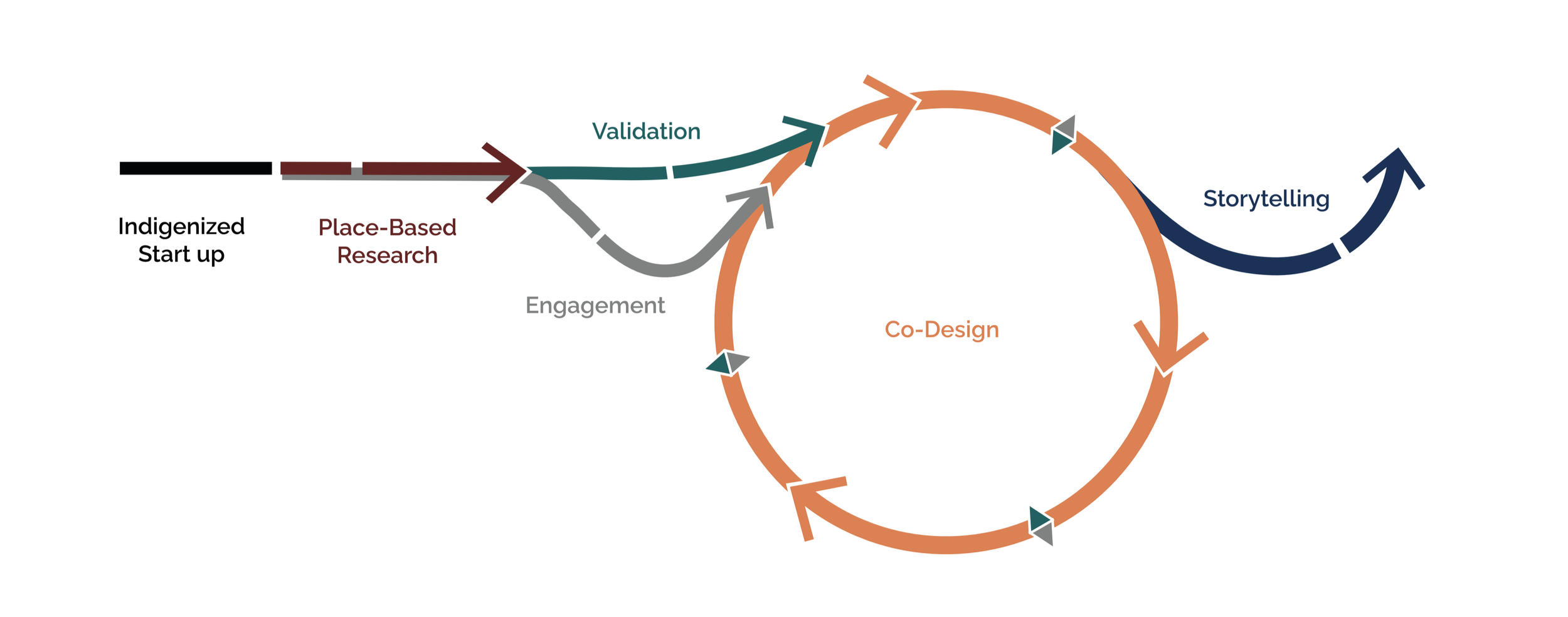
We use a process called the Indigenous Placekeeping Framework™ to guide design innovation for architecture, landscapes, masterplans and urban planning. This approach ensures an equitable design process and culturally responsive outcomes. The following description summarizes our five-phase process. The full IPKF process typically spans 3 to 10 days over the course of a project, but delivers immeasurable impact. To ensure spatial agency, TAWAW will not engage in design until Phase 4.
-
Before design work begins, we first Align by engaging with the Owner group to understand their mission, desired process, and key community voices, while considering local norms, engagement levels, and opportunities for reciprocity. Next, we Extend our team to include local experts—leaders, artists, Elders, youth, and master builders—bringing essential knowledge and lived experience. In the Plan phase, we collaborate with the Owner's team to create a roadmap, including an engagement or validation strategy, ensuring clear communication and follow-up with user groups. Finally, we Measure success by co-developing impact metrics with the Owner's group, tracking measurable outcomes and transformative change.
Next, we extend our team by inviting local experts—leaders, Elders, artists, culture bearers, and knowledge keepers—to participate. Their lived experience and place-based knowledge guide the direction and relevance of the project. Together, we develop a comprehensive engagement plan, mapping out when and where community conversations will happen, and how we’ll share back what we’ve learned. Finally, we co-create measurable outcomes with the Owner group to track both immediate and long-term impacts.
-
This phase is intended to increase cultural fluency before the project begins but is also useful to seed conversations in the community. Our research approach begins with understanding what is important to the people, including ongoing revitalization efforts, earth stewardship principles, and the social norms that govern their communities. We focus on local architectural traditions, studying significant forms, materials, and their cultural meanings, and exploring passive design strategies that may offer innovative insights. Material culture is also central as we investigate symbolic materials, arts, and crafts that could inspire design. Additionally, we study the landscape - natural landmarks, directional alignments, ethnobotany, and sacred places – to recognize and uplift the community’s history with the land. This research is completed in a few days.
-
A truly collaborative design process is essential to the success of every project. At TAWAW, we create inclusive, engaging, and culturally respectful pathways for participation with Indigenous communities and user groups. We use visual tools like imagery and mapping to spark conversations and ensure accuracy and authentic representation. Our adaptable methods work for large gatherings, focus groups, or one-on-one sessions, and are often geared toward consensus-based decision-making to honor the collective voice. Depending on the project context, the team chooses one of two approaches:
Validation:
When extensive prior engagement or documentation exists, a validation process may replace engagement. Designers review all existing assets – reports, transcripts, studies and narrative – through the PBR lens. Key findings are presented to a small validation circle for confirmation, refinement or contextual update. This streamlined model honors previous voices while preventing consultation fatigue and unnecessary duplication.
Engagement:
When foundational information is missing or the community requests broad participation mfull engagement processes are used. Workshops, sharing circles, and open gatherings encourage storytelling, mapping and collective visioning. We are often guided by a small Indigenous representative group.
-
In this phase, we take the Indigenous Design Drivers, vetted by community to the full consultant team to ensure understanding and preservation of key ideas. The design process is viewed as a collaborative act. Using the design drivers, the team develops concepts through iterative dialogue with the advisory or validation circle. Each design iteration is reviewed for alignment with community priorities and cultural values. Success indicators are checked to ensure success is viewed through the community’s viewpoint. Visual storytelling accompanies this process – diagrams, sketches and materials that document how meaning is expressed spatially – are inserted into the final report called Cultural Interpretive Strategy.
-
The final phase returns the narrative to the community. It celebrates outcomes and communicates how teachings shaped the design. Storytelling reinforces transparency and supports ongoing learning – ensuring the project continues to serve as a living teaching tool for future generations. Outcomes can include publications, site ceremonies, videos or exhibitions – all co-authored with community partners.
Community Words
“If someone were considering working with Tawaw, I’d tell them this: you’re not just hiring architects—you’re partnering with storytellers, listeners, and bridge-builders who understand that design can be a powerful tool for reconciliation and healing.”